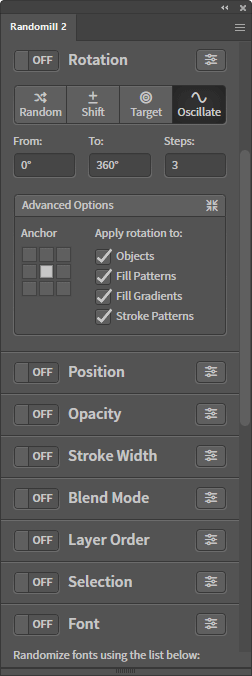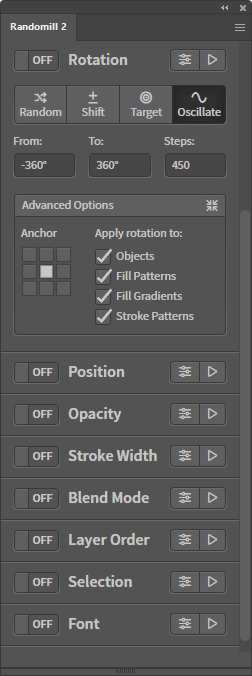
Randomill’s random rotate illustrator script allows for fast generation of interesting and unique designs, and is especially powerful when used in tandem with Randomill’s other functions. Randomize, offset, approach, and oscillate object rotation with intuitive and customizable settings.
Randomize Mode
Randomill can randomize rotation in Adobe Illustrator with customizable rotation ranges and step sizes. Rotation can even be set to apply only to fill gradients, patterns, or stroke fills.

Randomly rotate objects in Adobe Illustrator
Just type in a minimum and maximum value in the panel settings, and Randomill will randomly choose a value in that range to rotate each object by. The step size value allows for randomizing rotation by an increment.
Using the Anchor selection grid in the Advanced Options rollout, you can specify which anchor (or ‘reference point’) each object will be rotated around. To further increase the randomness of your design, you can check the Random Anchor checkbox to make it so each object will be rotated from a randomly chosen anchor.
Randomly rotate just one property of an object
Random rotation can be applied to just the objects, just their gradient fills, fill patterns, or stroke patterns independently to get the exact result you desire. Just select which properties you’d like rotation to apply to under the ‘Apply rotation to’ section in the Advanced Options rollout.


Shift Mode
Gradually rotate objects by a specified amount while looping through your selection.

Rotate an object by a specific degree more than the object before it
This mode can be used to increasingly shift the rotation angle objects in a set by a specified amount more than the previous object that Randomill iterated over.
For example, let’s say you have four 100pt x 100pt squares and you shift the rotation of these squares by 15 degrees. The result would be:
- Square 1: Unchanged.
- Square 2: Rotated by 15 degrees.
- Square 3: Rotated by 30 degrees.
- Square 4: Rotated by 45 degrees.
You can restart the loop after some specified number of steps
If you only want to rotate every other square in the selection by 15 degrees, you can set this value to 1. With this setting, after one step, Randomill treats the next object as if it was the first in the selection.
If you want to rotate every square by 15 degrees, and not gradually increase the rotation, set this value to 0. This behaves similarly to Illustrator’s native ‘Transform Each’ function, with the added benefit of being able to rotate just fill patterns, fill gradients, or stroke patterns.
You can also optionally include the first object to be included in the rotation operation as well.


Target Mode
Rotate each object in a selection gradually such that the last object is rotated by your target value. In other words, loop over a set of objects and rotate them such that the last object in the selection (in terms of layer order) will have be rotated by the target value.

Example: imagine you have a series of 6 squares next to each other. The top-most square in the layer stack is on the left and the bottom-most square is on the right. If you select all these squares and set the target rotation to be 360° here is what the result would be:
Square 1: Unchanged.
Square 2: Rotated 72°.
Square 3: Rotated 144°.
Square 4: Rotated 216°.
Square 5: Rotated 288°.
Square 6: Rotated 360°.
You can see that as Randomill iterated through the squares, it rotated each square in equal increments until the last square was rotated by the target value.


Oscillate Mode
Rotate each object in a set by an oscillating value over a specified number of steps. Iterate over multiple objects in a selection and rotate each object by a value that bounces between the TO and FROM values.

Example: say you have 10 lines arranged next to each other with the leftmost line being the top object in the layer stack. If you oscillate the rotation of this set of lines from -90 degrees to 90 degrees over 3 steps, you would get this result:
Line 01: Rotated by -90°
Line 02: Rotated by -30°
Line 03: Rotated by +30°
Line 04: Rotated by +90°
Line 05: Rotated by +30°
Line 06: Rotated by -30°
Line 07: Rotated by -90°
Line 08: Rotated by -30°
Line 09: Rotated by +30°
Line 10: Rotated by +90°
The first line was rotated by the From value, and took 3 Steps to get to the To value. Another 3 steps were needed to get back to the From value.